Justice & Forensic Behaviour Support
From custody to community.

SERVICES
Accepting Referrals
|
Immediate Availability
|
Rapid Intake
|
Accepting Referrals | Immediate Availability | Rapid Intake |
People in the justice system often fall through service gaps, with support not reaching them when it’s needed most. Disability is significantly over‑represented and under‑supported, and many people are managing multiple diagnoses, trauma histories, unstable housing, and limited networks. Generic behaviour support that doesn’t understand how the justice system works often falls short.
Jennifer, somaterra’s founder and Behaviour Support Practitioner, has worked within custodial centres across NSW and QLD, and with community corrections, police, and the courts. This first-hand experience shapes somaterra’s justice and forensic services, built specifically to close these gaps.
SUPPORT THAT WORKS WITHIN BOUNDARIES
Behaviour Support & the Justice System
Behaviour support is about understanding why a behaviour is happening, not just managing it. Every behaviour has a purpose: communicating a need, responding to distress, or adapting to an environment that isn’t supporting the person well.
Quality behaviour support focuses on creating conditions for a good life: building skills, strengthening coping strategies, and expanding practical options a person can use.
In the justice system, environments and expectations change often — custody, release, supervision, and community — each with its own pressures, limits, and non‑negotiable requirements.
Effective behaviour support works within these boundaries and builds strategies that help the person meet conditions safely, consistently, and in ways that support their wellbeing.
Somaterra’s approach aligns with three stages of the justice pathway. Not everyone moves through all stages. Some people have spent time in custody, while others are managing community‑based orders. The focus is always on what the person needs now, and what will help create the conditions for a safer, more stable, and more supported life.
CUSTODY
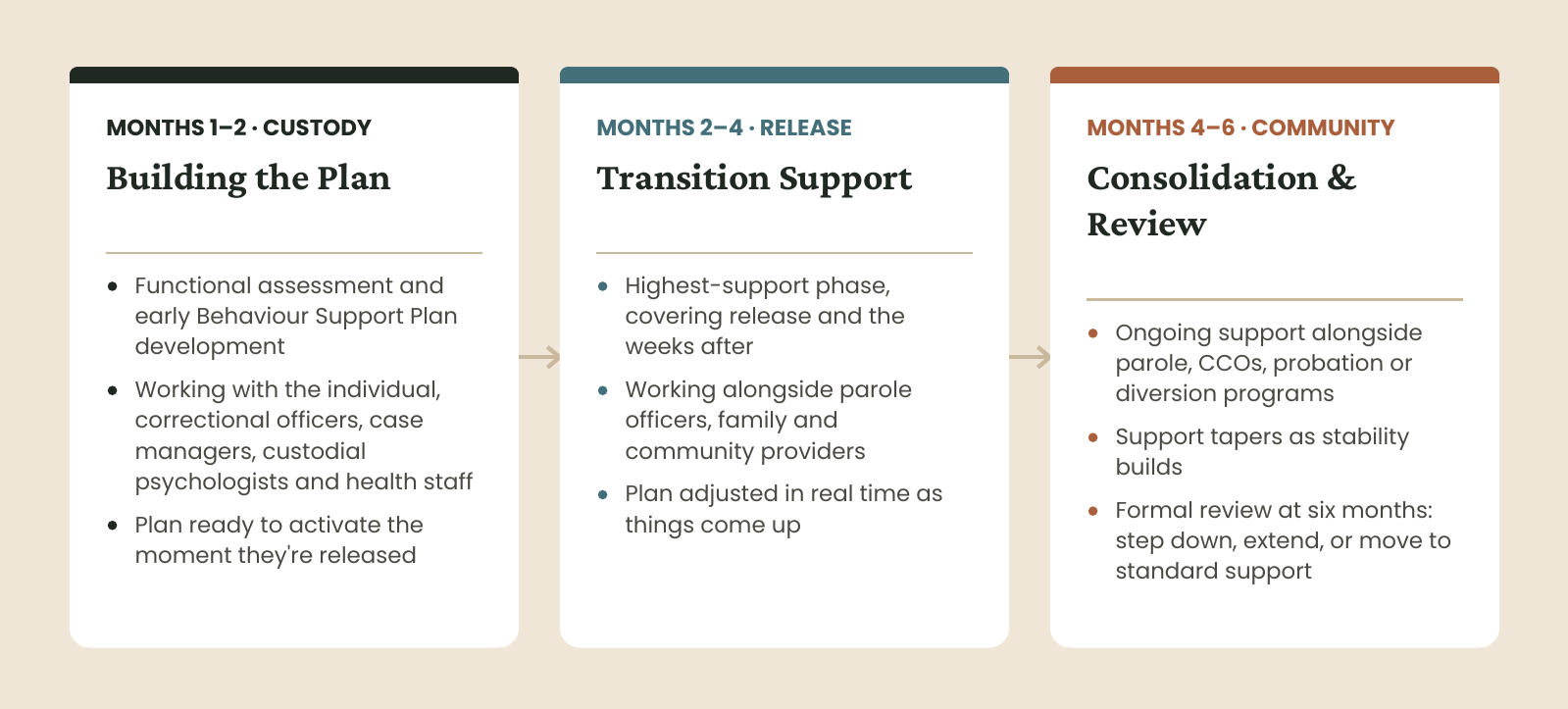
Support can begin while someone is still in custody. Building a behaviour support plan early means the person has something practical and ready to use the moment they return to community, rather than starting from scratch after release. Somaterra can work directly with the person in custody and alongside correctional officers, case managers, custodial psychologists, and health staff, so the transition to community is planned, coordinated, and focused on creating safer, more stable conditions for a good life.
RELEASE
The first weeks after release are often when support is thinnest, and when people need it most. Somaterra works alongside parole officers, family, and community providers to support individuals through this period. Housing instability, loss of routine, and re‑establishing relationships commonly collide here, increasing pressure and reducing predictability. This is also when behaviours linked to stress or unmet needs can escalate without the right supports in place. Somaterra’s role is to help create stability, build practical options, and support the person to meet their conditions safely and consistently.
COMMUNITY
Ongoing support is available for people managing parole, community corrections orders, probation, or diversion programs, whether or not custody has ever been part of their story. Somaterra works alongside corrections and parole officers to provide behaviour support that strengthens stability, builds practical options, and helps the person meet their conditions safely and consistently.
A 6-MONTH POSITIVE SUPPORT FRAMEWORK
Custody to Community Pathway
For adults navigating the transition out of custody specifically, somaterra offers a structured framework.
Who this is for:
This work is for people in contact with the criminal justice or forensic system, and for the services supporting them. Somaterra works with individuals managing complex or high‑risk behaviours, offending histories, and a range of disabilities and impairments.
Whatever someone’s history or diagnosis, the approach is the same: understanding the person, the function behind their behaviour, and building the conditions for a safer, more stable, and more supported life.
If you work with someone in custody, approaching release, or navigating community corrections or a community‑based order, or if this is you, and you’re looking for behaviour support that understands the justice system, Somaterra can help.